There’s been no shortage of discussion around how AI can help developers write code faster. Most examples focus on prompts, snippets, or productivity gains at the implementation level.
What’s discussed far less is how AI changes the shape of delivery on a real project - particularly when it’s used across more than just coding.
On the recent rebuild of the IDHL website using Xperience by Kentico, we deliberately integrated AI across most of the delivery lifecycle. The goal wasn’t to replace thinking or decision-making, but to reduce friction between stages and move more quickly from ideas to validated implementations.
The biggest shift wasn’t faster coding. It was removing the overhead between modelling, planning, and implementation.
Change in approach during the IDHL site rebuild
At IDHL, we normally invest significant time upfront defining specifications, content models, and delivery plans. That early thinking is still critical - it sets direction, reduces risk, and prevents expensive rework.
That didn’t change.
What did change was how that work was carried out.
Rather than relying entirely on manual documentation and translating between formats, we used AI to accelerate the creation of initial artefacts. This allowed us to move from ideas and designs to something concrete much earlier, without lowering standards.
The output wasn’t final - it was a starting point that we could review, challenge, and refine.
Across the project, a clear pattern emerged.
AI reduced the cost of moving between stages of delivery.
This shift is easiest to see when looking at the delivery lifecycle:
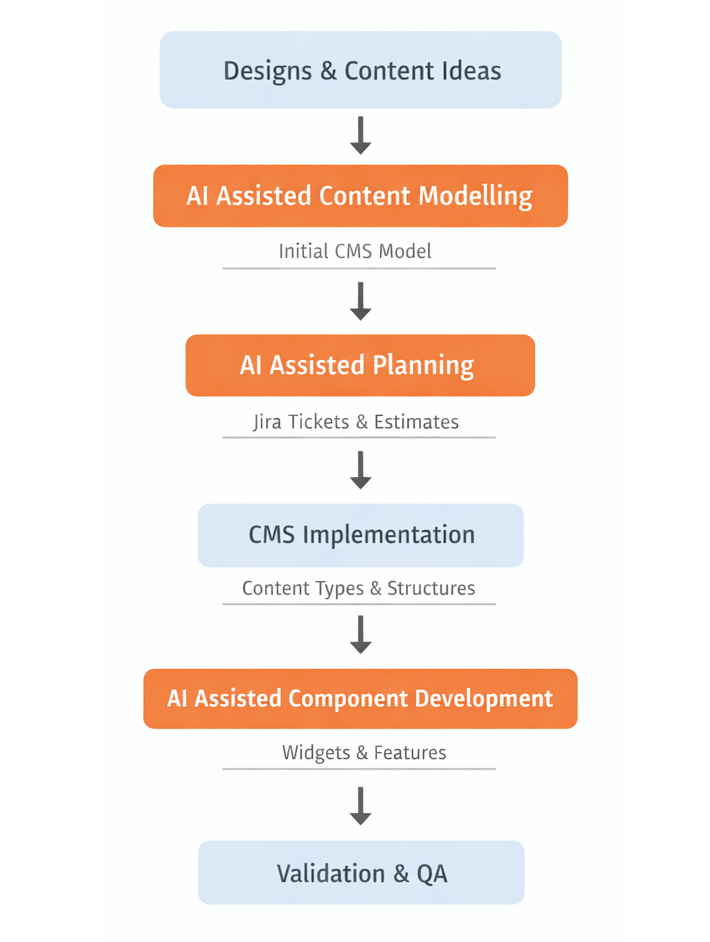
AI‑assisted content modelling
The first place this had a noticeable impact was content modelling.
We generated an initial model using the Content Modelling MCP Server, part of KentiCopilot - Kentico’s suite of AI-assisted development tools. This combined inputs from Figma designs, sitemap structure, and early discussions.
The goal wasn’t to accept the model as-is, but to create something tangible early that made it easier to validate decisions.
Key impact: abstract discussions became concrete much sooner.
This also lowered the barrier for contributors who were less familiar with Xperience by Kentico. Because the starting point already aligned with platform best practices, team members could engage meaningfully without needing deep platform knowledge - for example, developers coming from other CMS platforms like Umbraco.
Using AI to plan and write a specification
Once the model was agreed, the next step was translating it into a delivery plan.
Instead of manually converting the model into tickets, we used Claude Code and the Atlassian MCP server to generate Jira tickets for content types, components, and widgets. This included titles, descriptions, and initial effort estimates based on defined rules.
The key difference here was that the translation cost largely vanished.
Instead of re-expressing the same information in another format, AI handled the conversion for us. That allowed the team to focus on reviewing and refining the output rather than producing it from scratch.
Planning conversations happened earlier, with clearer context and much less overhead.
Configuring content types in the platform
Configuring content types in Xperience by Kentico typically requires a fair amount of backend setup - fields, controls, descriptions, relationships.
Using the Content Management MCP Server, much of this was delegated to an AI agent and completed in a fraction of the time.
The important shift was not removing the need for validation, but creating the space to do it properly.
AI‑assisted CMS implementation
Implementation followed an agentic, human‑in‑the‑loop approach.
With a defined content model and a Jira ticket in place, AI-assisted agents were used to:
- Review requirements
- Propose an approach
- Produce an initial implementation
Developers no longer started from an empty file.
Instead, the focus shifted to reviewing, refining, testing, and ensuring the implementation behaved correctly within the wider system.
Time that would previously have been spent on boilerplate was reallocated to validation and quality.
AI produced the first-pass implementation. Developers retained ownership of structure, correctness, and final outcomes.
Applying CMS updates more reliably
Updating an Xperience by Kentico project involves following a sequence of steps and validating changes carefully.
By using an AI agent with a custom update skill, this process became more consistent and less dependent on manual interpretation of steps and changelogs.
This reduced the risk of simple errors, such as missed steps or misread instructions.
What didn’t change
AI-generated output was never treated as definitive.
Architectural decisions, trade-offs, and implementation quality remained firmly with the team. AI accelerated delivery, but it did not replace judgment.
The real impact
The implementation required noticeably less effort than initially planned - not because less work was needed, but because less effort was spent moving work between stages of delivery.
There was less waiting, less uncertainty, and fewer delays in decision-making.
Work flowed more smoothly from modelling to planning to implementation, with time redirected toward validation rather than creation.
For digital decision makers, the value of AI isn’t just faster coding. It’s about:
- Reducing uncertainty
- Compressing decision cycles
- Removing repetitive translation work
- Increasing confidence during delivery
Used thoughtfully, AI doesn’t replace experience - it amplifies it.
Final thoughts
What worked here won’t apply to every project.
But this rebuild reinforced a key point: the biggest gains from AI come when it’s embedded into how work gets done, not added at the end.
The real advantage isn’t just faster development - it’s a change in how teams move through delivery, with less friction between decisions and implementation.